Mapas referenciales
Esposición Sin Tierra de Rafael Guendelman Hales en el Museo de la Solidaridad Salvador Allende
Rocio Olivares
La exposición Sin Tierra de Rafael Guendelman Hales en el Núcleo Contemporáneo del Museo de la Solidaridad Salvador Allende, propone un acercamiento personal frente al conflicto palestino-israelí, específicamente sobre la ocupación de territorios palestinos en Cisjordania donde el artista estuvo durante siete meses.

Guendelman presenta su ascendencia palestina y judía –por parte de su madre y su padre respectivamente– como una especie de punto de partida para trabajar y realizar observaciones sobre el conflicto.
Enfrentarse a un conflicto ajeno a nuestra inmediatez, y especialmente a uno tan mediatizado como lo es el problema palestino-israelí, presenta una serie de obstáculos al momento de establecer un acercamiento personal y respetuoso frente el tema, donde es necesario algo más que empatía para poder realizar observaciones que vayan más allá de los lugares comunes, el mero registro o incluso la posible explotación de la situación. Para construir un trabajo a partir de esto, se vuelve imprescindible hacerse cargo del rol jugará el artista.
Dentro de la muestra son, a mi parecer, los trabajos Ana Men Chile como Recolecciones, los que dejan entrever el territorio sobre el cual Guendelman decide situarse como artista y a la vez, proponer preguntas sobre el lugar que ocupa el mismo frente al conflicto.

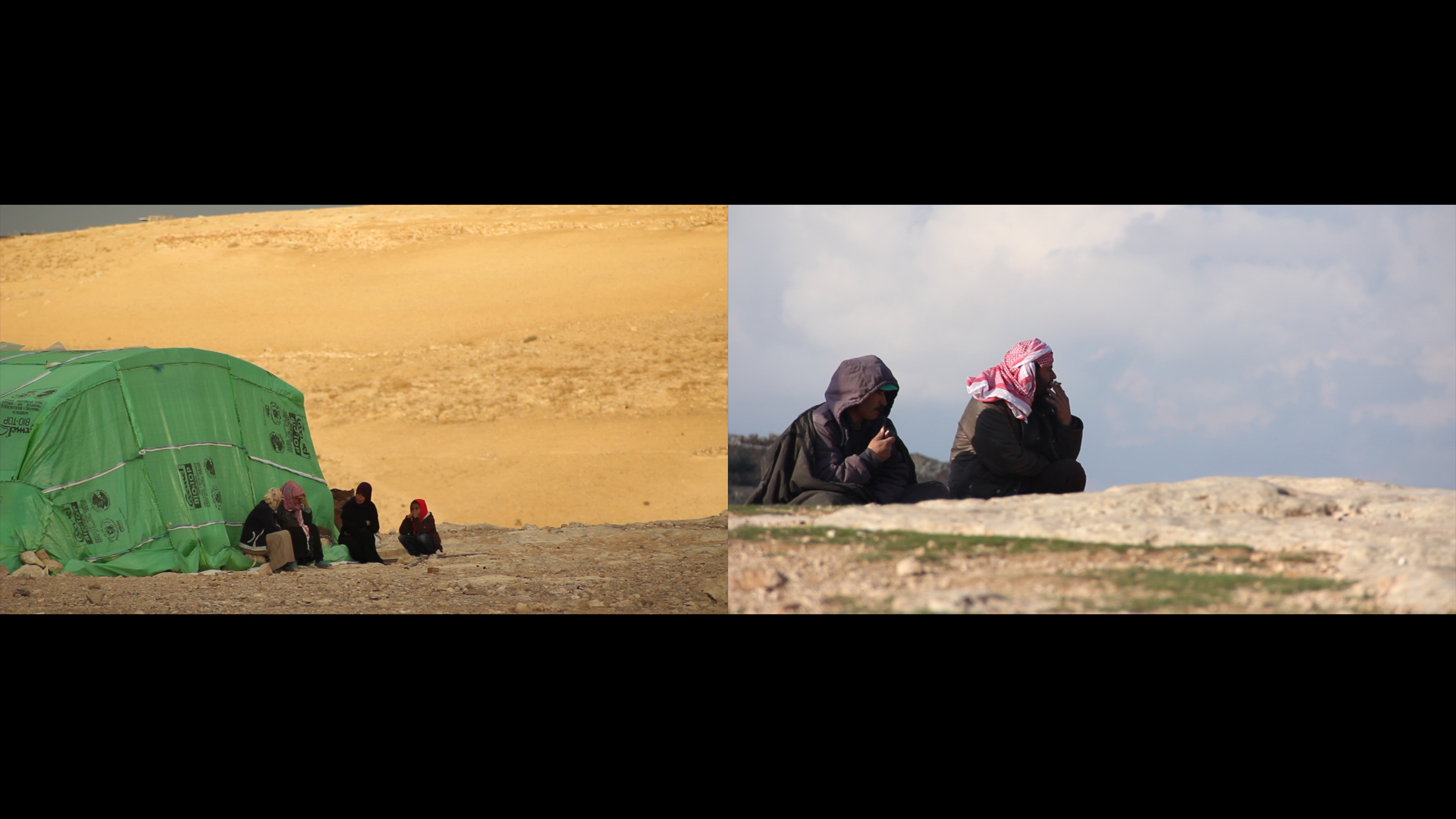
El video Ana Men Chile se articula a partir de diversos planos que buscan dar cuenta del conflicto desde el paisaje. Mediante diferentes recursos éste va revelando las marcas que deja la apropiación territorial o la reclamación de lugares ya perdidos. Las imágenes transitan entre las que son claras para el ojo desinformado (el registro de checkpoints, entre otros), las que solo dejan la ambigüedad a partir del contraste con otras, las que cumplen su función como metáforas, y hasta las que en apariencia se presentan como despolitizadas. Esto es, en mi opinión, una de las decisiones que aportan a dar cuenta de la complejidad y la cantidad de capas presentes en el conflicto a las que el artista puede acceder al involucrarse como espectador. La edición de imagen combina así violencia, ambigüedad y pequeñas reivindicaciones simbólicas para el pueblo palestino (como es el caso de los planos contrapuestos entre una protesta palestina y otra israelí) donde a pesar de sobreentenderse una postura política, no se acerca al video a la militancia.
Esta edición de imagen se contrasta con los diálogos de descendientes de palestinos residentes en Chile. A pesar de que varios de los testimonios muestran una profunda identificación con el conflicto, se hace presente en todo momento la distancia entre éstos y el registro visual. Este contraste establece una serie de preguntas con respecto a la identidad y como esta se establece a partir del relato.
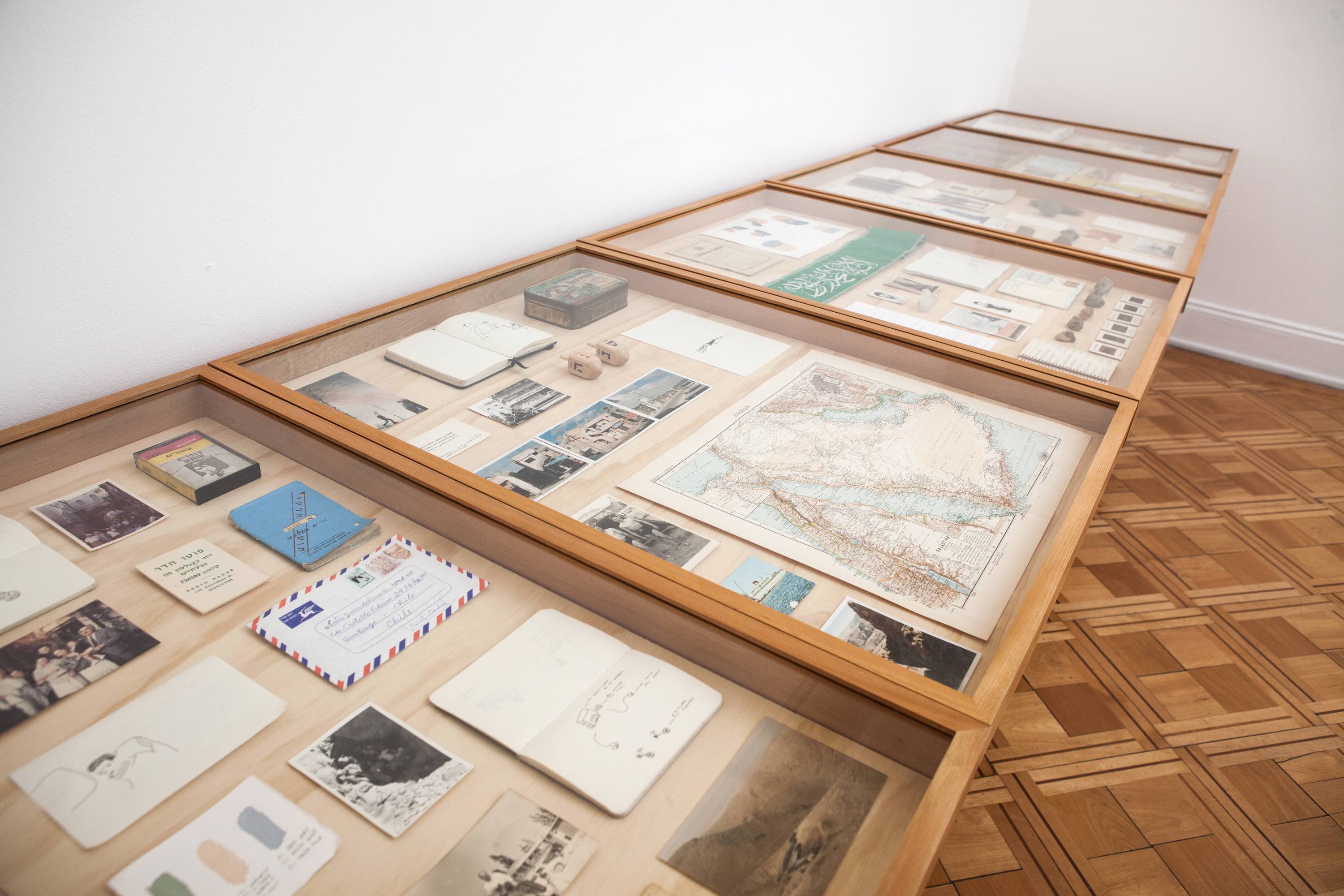
Recolecciones, por otro lado, consiste en una agrupación de vitrinas que exhiben una serie de objetos que al parecer se encuentran ahí gracias a un apego afectivo por parte del artista. Dibujos, mapas, recuerdos familiares y otros objetos adquiridos por Guendelman durante su estadía en Cisjordania, ebozan una especie de relato sobre las historias de las familias materna y paterna. Un texto que registra una conversación con su padre, entra como una especie de hilo conductor que traza su experiencia y relación con Isreal hasta enunciar su matrimonio con una palestina residente en Chile.
De esta forma, Guendelman nos permite conocer la fuente de origen por su interés en el tema, exponiendo el vínculo afectivo que el establece con el conflicto. De esta manera el artista, toma una postura honesta sobre su rol, admitiendo su apego. Su lugar como testigo se admite, entonces, como no tan lejana al papel que juegan los testimonios en Ana Men Chile.
El viaje, que inevitablemente establece una metáfora con respecto a la vuelta al origen y la búsqueda de la fuente de información original es, a pesar de todo, insuficiente para lograr derribar la distancia propia del testigo, a pesar del profundo proceso de empatía que éste pueda haber significado.
Sin embargo, este vínculo biográfico entrega la posibilidad de imaginar una serie de relaciones distintas del artista con respecto al conflicto. Finalmente con que elegimos identificarnos o conciliar dentro de nuestra propia identidad corresponde realmente al relato que elijamos fundar. Qué significa esta búsqueda para el artista y cómo esta propone una narración sobre identificación y la conformación de una imagen personal son vacíos en los cuales el espectador puede proyectar interpretaciones y expectativas.

Creo que la tensión entre estas dos posiciones, en primer lugar, la del testigo y en segundo, la del apego afectivo que de alguna manera el sujeto siente experimentar de forma personal y directa; propicia un trabajo que logra no presentarse como conclusivo al respecto e instalar ciertas preguntas interesantes. Cómo nos definimos frente a la distancia que percibimos con respecto al otro, cómo formamos identidad a partir del relato, cómo este nos puede llevar a sensibilizarnos al punto de sentir como propios problemas ajenos a nuestra inmediatez y cómo, a su vez, ciertos conflictos vienen a ser una especie de reflejo de miles de otros existentes; creo que son algunas de las preguntas que vale la pena continuar haciéndonos.
Es acá donde para mí se encuentra el verdadero rendimiento Sin Tierra: en la posibilidad de presentar la empatía e identificación como un fenómeno selectivo que muchas veces define quién elegimos ser y con que deseamos comulgar. En este aspecto el primer plano de Ana Men Chile viene a presentarse como una especie de metáfora de esta situación. Dos imágenes en paralelo, una de una población palestina y otra de una israelí, entre las cuales mi ojo chileno desinformado logra encontrar una serie de similitudes… hasta que uno de los testimonios me hace reparar en sus diferencias.
Reference Maps
No Land Exhibition by Rafael Guendelman Hales at the Salvador Allende Museum of Solidarity
Rocio Olivares
Rafael Guendelman Hales’ exhibition No Land at the Núcleo Contemporáneo of the Salvador Allende Museum of Solidarity offers a personal perspective on the Palestinian-Israeli conflict, specifically focusing on the occupation of Palestinian territories in the West Bank, where the artist spent seven months.
Guendelman presents his Palestinian and Jewish heritage—from his mother and father, respectively—as a sort of starting point for exploring and reflecting on the conflict.
Confronting a conflict outside our immediate experience—and especially one as heavily publicized as the Palestinian-Israeli issue—presents a series of obstacles when attempting to establish a personal and respectful approach to the subject. It requires more than empathy to make observations that go beyond clichés, mere documentation, or even the potential exploitation of the situation. To build a body of work based on this, it becomes essential to address the role the artist will play.

Within the exhibition, it is, in my view, works such as Ana Men Chile’s Recolecciones that offer a glimpse into the territory within which Guendelman chooses to position himself as an artist, while simultaneously raising questions about the place he occupies in relation to the conflict.
The video Ana Men Chile is structured around a series of shots that seek to capture the conflict through the landscape. Using various techniques, it gradually reveals the traces left by territorial appropriation or the reclamation of places already lost. The images range from those that are clear to the uninformed eye (such as footage of checkpoints), to those that are ambiguous only in contrast to others, to those that function as metaphors, and even to those that appear to be depoliticized. This is, in my opinion, one of the decisions that helps convey the complexity and the many layers present in the conflict that the artist can access by engaging as a spectator. The image editing thus combines violence, ambiguity, and small symbolic acts of solidarity with the Palestinian people (as in the case of the juxtaposed shots of a Palestinian protest and an Israeli one), where, despite the implied political stance, the video does not veer toward militancy.
This image editing contrasts with the dialogues of descendants of Palestinians living in Chile. Although several of the testimonies reveal a deep identification with the conflict, the distance between them and the visual record is ever-present. This contrast raises a series of questions regarding identity and how it is established through narrative.
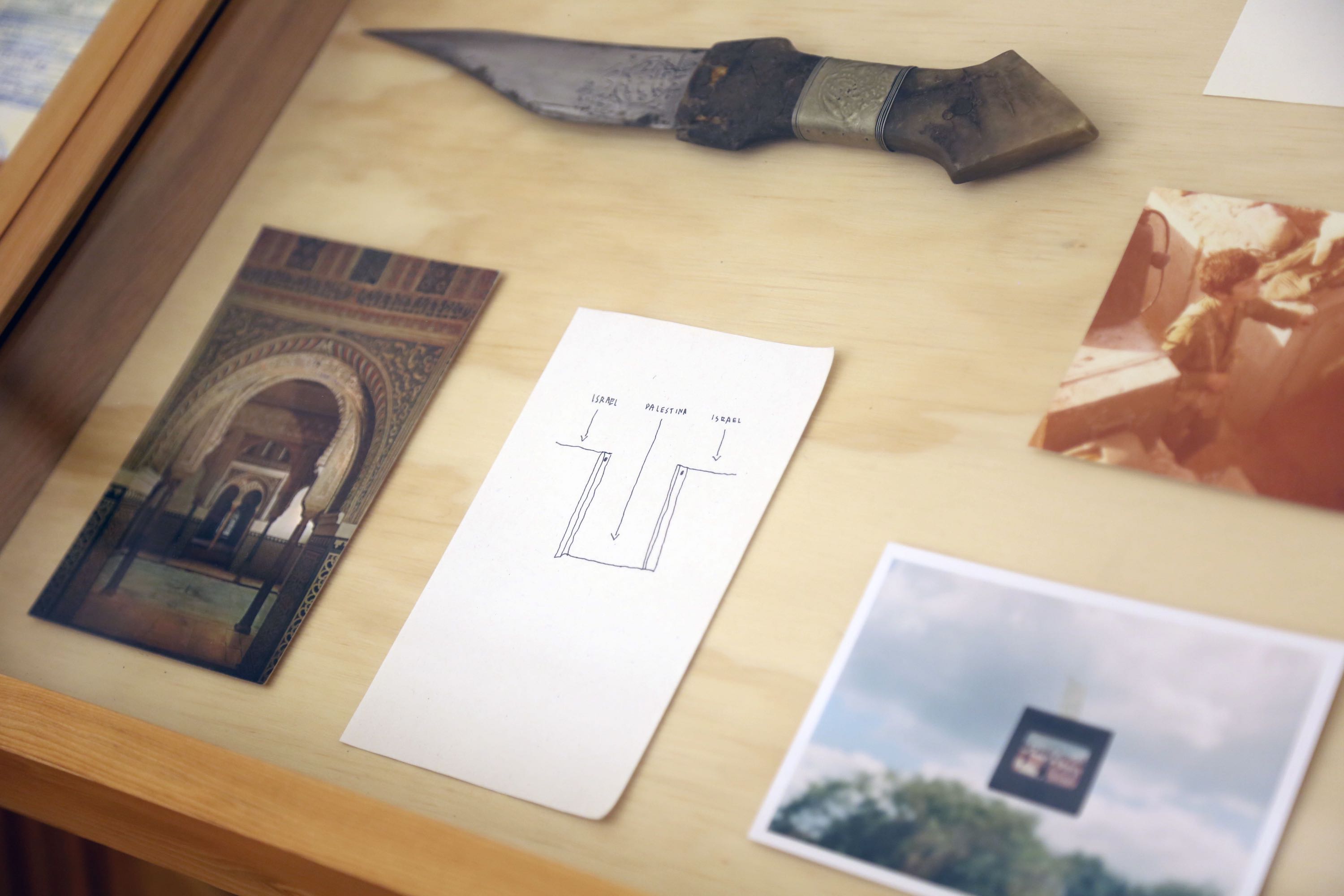
“Recolecciones”, on the other hand, consists of a group of display cases showcasing a series of objects that appear to be there due to the artist’s emotional attachment to them. Drawings, maps, family mementos, and other objects acquired by Guendelman during his stay in the West Bank sketch out a kind of narrative about the histories of his maternal and paternal families. A text recording a conversation with his father serves as a kind of thread that traces his experience and relationship with Israel, culminating in his marriage to a Palestinian woman living in Chile.
In this way, Guendelman allows us to understand the source of his interest in the subject, revealing the emotional bond he establishes with the conflict. Thus, the artist takes an honest stance regarding his role, acknowledging his attachment. His position as a witness is thus recognized as not so distant from the role played by the testimonies in Ana Men Chile.
The journey, which inevitably establishes a metaphor regarding the return to one’s origins and the search for the original source of information, is, despite everything, insufficient to bridge the distance inherent to the witness, despite the profound process of empathy it may have entailed.
However, this biographical link offers the possibility of imagining a range of different relationships the artist might have with the conflict. Ultimately, what we choose to identify with or reconcile within our own identity depends entirely on the narrative we choose to construct. What this search means for the artist, and how it proposes a narrative about identification and the formation of a personal image, are gaps into which the viewer can project interpretations and expectations.
I believe that the tension between these two positions—first, that of the witness, and second, that of the emotional attachment that the subject somehow feels on a personal and direct level—gives rise to a work that manages not to present itself as conclusive on the matter and instead raises certain interesting questions. How we define ourselves in the face of the distance we perceive from the other, how we form identity through narrative, how this can lead us to become so sensitized that we feel problems outside our immediate reality as our own, and how, in turn, certain conflicts come to be a kind of reflection of thousands of others that exist—I believe these are some of the questions worth continuing to ask ourselves.

This is where, for me, the true power of No Land lies: in its ability to present empathy and identification as a selective phenomenon that often defines who we choose to be and with whom we wish to align ourselves. In this regard, the close-up of Ana Men Chile serves as a kind of metaphor for this situation. Two parallel images—one of a Palestinian community and the other of an Israeli one—between which my uninformed Chilean eye manages to find a series of similarities… until one of the testimonies makes me notice their differences.
